ENG
ENG FRA
FRA

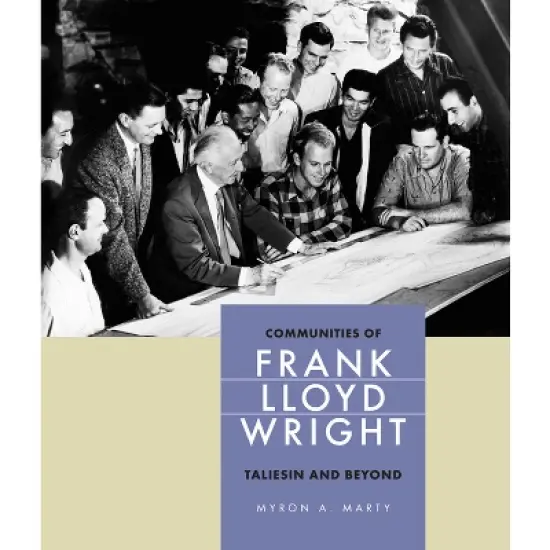
Communities of Frank Lloyd Wright - by Myron Marty (Hardcover)
Disponibilité:
En stock-
Livraison estimée:Sep 19 - Sep 26
-
Expédition et retours gratuits: On all orders

Paiement sécurisé garanti
- Free Shipping & Returns or all orders over
- Secure Payment We ensure secure payment
- Money Back Guarantee Any back within 30 days
Product Description
About the Book
Despite the numerous studies of Frank Lloyd Wright's life and architecture, little has been published about his life in relation to the communities that dominated his life. Wright, a fervent believer in individualism and an ardent advocate of democracy, worked in communities throughout his career of more than six decades. These communities, which he led with unquestioned authority, made possible his extraordinary productivity. They also helped sustain his genius, provided him with crucial social outlets, and made it possible for him to remain a creative force outside the mainstream of American architecture until his death at age 91.
Almost immediately after arriving in Chicago in 1887, Wright began working in the company of architects and draftsmen, most notably Joseph Lyman Silsbee, Dankmar Adler, and Louis Sullivan. In 1893 he opened his own practice in downtown Chicago and formed relationships with communities of young architects and draftsmen there. Five years later Wright moved his venture to his home and studio in Oak Park. Although his community of coworkers there was highly productive, in 1909 he abandoned them, his practice, and his family, turned his projects over to others, and left for Europe with his mistress. In the next twenty years he formed incidental communities wherever his work took him, including Europe, Japan, California, and Arizona, while maintaining his base at Taliesin, his home near Spring Green, Wisconsin. In 1932, after years of hardship, Wright and his third wife, Olgivanna, founded the Taliesin Fellowship, a community of apprentices and assistants. Five years later the Fellowship began to spend winters at Taliesin West, a camp he designed in Scottsdale, Arizona. When Wright died in 1959, his widow became the Fellowship's unchallenged leader, and she remained so until her death 26 years later. Marty's groundbreaking work is neither a biography of Wright nor a study of his architecture; rather, it is the story of his life in communities, particularly the Taliesin Fellowship. This study will be of interest to Wright scholars and enthusiasts, architects, architectural historians, and architecture students.Book Synopsis
Despite the numerous studies of Frank Lloyd Wright's life and architecture, little has been published about his life in relation to the communities that dominated his life. Wright, a fervent believer in individualism and an ardent advocate of democracy, worked in communities throughout his career of more than six decades. These communities, which he led with unquestioned authority, made possible his extraordinary productivity. They also helped sustain his genius, provided him with crucial social outlets, and made it possible for him to remain a creative force outside the mainstream of American architecture until his death at age 91.
Almost immediately after arriving in Chicago in 1887, Wright began working in the company of architects and draftsmen, most notably Joseph Lyman Silsbee, Dankmar Adler, and Louis Sullivan. In 1893 he opened his own practice in downtown Chicago and formed relationships with communities of young architects and draftsmen there. Five years later Wright moved his venture to his home and studio in Oak Park. Although his community of coworkers there was highly productive, in 1909 he abandoned them, his practice, and his family, turned his projects over to others, and left for Europe with his mistress. In the next twenty years he formed incidental communities wherever his work took him, including Europe, Japan, California, and Arizona, while maintaining his base at Taliesin, his home near Spring Green, Wisconsin.
In 1932, after years of hardship, Wright and his third wife, Olgivanna, founded the Taliesin Fellowship, a community of apprentices and assistants. Five years later the Fellowship began to spend winters at Taliesin West, a camp he designed in Scottsdale, Arizona. When Wright died in 1959, his widow became the Fellowship's unchallenged leader, and she remained so until her death 26 years later.
Marty's groundbreaking work is neither a biography of Wright nor a study of his architecture; rather, it is the story of his life in communities, particularly the Taliesin Fellowship. This study will be of interest to Wright scholars and enthusiasts, architects, architectural historians, and architecture students.
Review Quotes
A detailed account of one of America's least understood and most significant examples of a true live/work, cultural/educational community, all as seen through the experiences of those who were there to make it happen.
--Vernon Swaback, FAIA, FAICP: 20-year member of the Taliesin Fellowship and former Chairman of the Frank Lloyd Wright FoundationAn essential book on the thought and action of Frank Lloyd Wright through his relationship to communities.
--Eric Lloyd Wright, grandson, architect and former apprenticeMarty offers insights into the public and private life of Wright that have not been previously revealed.
--H. Roger Grant, Clemson UniversityAbout the Author
Myron A. Marty is the coauthor, with Shirley Marty, of Frank Lloyd Wright's Taliesin Fellowship. A former member of the Board of Trustees of the Frank Lloyd Wright Foundation as well as the Board of Taliesin Preservation, Inc., Marty is the Ann G. and Sigurd E. Anderson University Professor Emeritus and Dean of Arts and Sciences Emeritus at Drake University.
Product Highlights
- Despite the numerous studies of Frank Lloyd Wright's life and architecture, little has been published about his life in relation to the communities that dominated his life.
- About the Author: Myron A. Marty is the coauthor, with Shirley Marty, of Frank Lloyd Wright's Taliesin Fellowship.
- 316 Pages
- Architecture, Individual Architects & Firms
- Dimensions (Overall): 10.2 Inches (H) x 8.5 Inches (W) x .9 Inches (D)
- Weight: 2.55 Pounds
- Suggested Age: 22 Years and Up
- Number of Pages: 316
- Genre: Architecture
- Sub-Genre: Individual Architects & Firms
- Publisher: Northern Illinois University Press
- Theme: General
- Format: Hardcover
- Author: Myron Marty
- Language: English
Soumettez vos commentaires
Your email address will not be published. Required fields are marked *
Vous aimerez aussi
Plus de produits